Jessica Palairet, Executive Director of Lawyers for Climate Action NZ, gives a rundown of this landmark case.
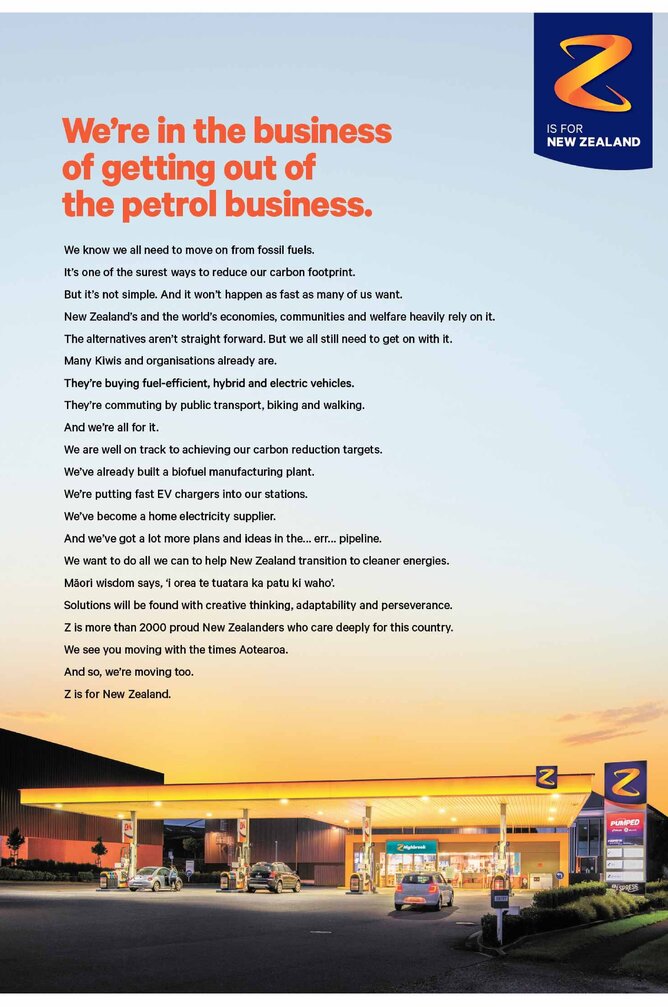
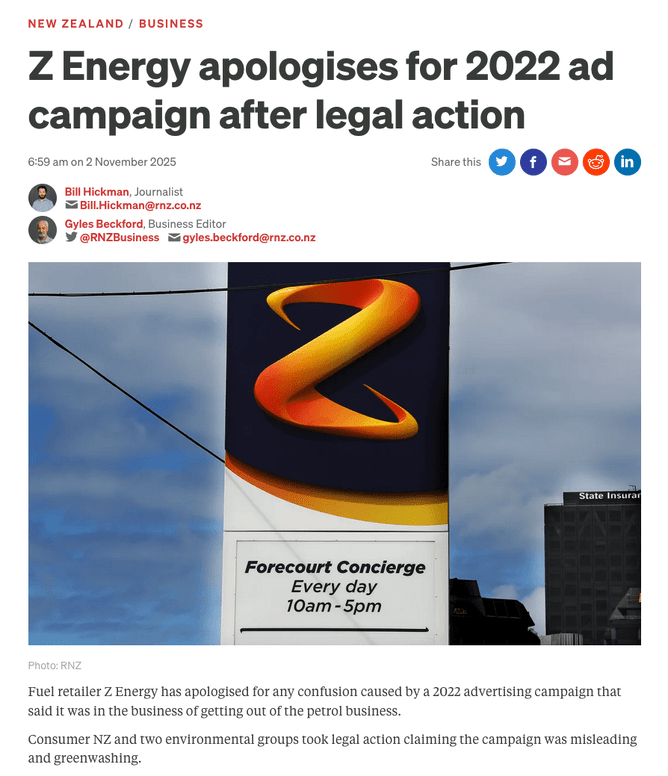
In 2022, Z Energy told New Zealanders that it was “in the business of getting out of the petrol business”. In November 2025, after we took them to court, Z Energy paid for full-page newspaper ads to apologise for any confusion its campaign caused.
This was New Zealand’s first climate greenwashing case - and New Zealand’s first settlement of a greenwashing case.

What this case was about
Z Energy ran a campaign back in 2022 claiming it was “moving with the times” and “in the business of getting out of the petrol business”.
Lawyers for Climate Action lodged a complaint with the Commerce Commission, arguing that the campaign was misleading. When the Commission declined to act, we teamed up with two other charities, Consumer NZ and the Environmental Law Initiative, and took the case to the High Court.
In our view, this campaign was a homegrown example of a concerning worldwide trend: fossil fuel companies trying to boost their businesses by painting themselves as part of the climate solution, while continuing to sell the petroleum products that are literally fuelling climate change.
While telling New Zealanders that it was “in the business of getting out of the petrol business”, Z was telling its investors that it planned to “optimise its core business” - which, of course, is selling petrol.
Z also claimed to be on track to meet its carbon reduction targets. It pointed to its biofuel manufacturing plant, EV chargers at petrol stations, and its move into electricity retailing as evidence. In reality, we say that by the time the campaign went live, Z had mothballed its biofuel plant, didn’t have a large number of EV chargers, and its electricity retail business was never going to make a meaningful impact on emissions.
We wanted to set an example for other New Zealand companies: there are consequences for not being careful and accurate when making green claims - even when our regulators are too timid to act. So we sought declarations from the High Court under the Fair Trading Act that Z Energy’s campaign was misleading.
As a result, we sought declarations from the High Court under the Fair Trading Act that Z Energy’s campaign was misleading.

The settlement
Almost two years to the day after we filed the case, we announced that it had been settled. As part of the settlement, Z Energy apologised for any confusion caused by parts of its campaign, and to any customers who thought it was going to stop selling petrol any time soon.
Z Energy paid for full-page newspaper adverts across the country to publish its apology and our settlement statement - just as it had done when it launched its “moving with the times” campaign. The settlement statement included key statements about fossil fuels and the importance of making truthful claims to consumers.
The agreement to settle did not include any payment to the three plaintiffs. As often is the case in legal settlements, Z Energy did not admit liability under the FTA and does not consider its actions to be greenwashing or to involve misleading and deceptive conduct.
Remarkably, Z Energy also agreed with the plaintiffs that transport emissions - including from the fuel it sells - are a big part of New Zealand’s emissions, and that fossil fuels are a leading contributor to climate change. What’s more, it joined our call for the Government to step up and create supportive policy frameworks and regulations that encourage the energy transition away from fossil fuels.
Why the settlement matters
A key driver for bringing the case was to shine a spotlight on greenwashing in New Zealand and send a clear message to New Zealand businesses that they could be held to account for crossing the line.
By paying for full-page adverts featuring its apology and our settlement statement, as well as the cost, distraction and negative publicity the case has forced Z Energy to endure, this case has served as a deterrent to others considering campaigns that stray towards greenwashing.
While government and regulators have so far done little to enforce against greenwashing, we have shown that we are prepared to step in and fill that gap. Since we started the litigation, we certainly have not seen what we would consider greenwashing on a similar scale from other New Zealand companies.
In addition, settling the case now allowed us to get an outcome years earlier than a court judgment. Our case was set down for a one-month High Court trial in late 2027. That meant we were unlikely to get a judgment until 2028 - more than five years after Z launched its campaign. Given the strength and visibility of the apology, we decided a clear outcome now was better than a judgment when the campaign was a distant memory.
The wave of accountability is spreading. Z Energy’s apology follows an apology from Energy Australia in the settlement of a greenwashing case brought by Australian Parents for Climate Action, and comes at the same time as a landmark ruling in France against TotalEnergies’ greenwashing advertising. Outcomes like this show that the pressure is working.
We will continue to monitor the claims of major polluters, including Z Energy, to ensure they are meeting the law - and continue using the law to drive action on climate change.

Jessica Palairet is Executive Director of Lawyers for Climate Action NZ, a small legal charity in New Zealand that uses the law to drive action on climate change.
With 400 members from across Aotearoa New Zealand, they bring strategic climate litigation like the Z Energy greenwashing case, advocate for stronger climate law and policy, and run education and community-building events on climate change law and lawyering.
Jessica has written a chapter in the upcoming book, “Kiwis in Climate”, on the power of the law in responding to climate change.